Czech Diminutives: Not Only Small & Cute
 Zuzana Mikulecká10.3. 2026
If you spend any time around Czech speakers, you will quickly notice something: so many words have these tickling letters č and k. Words gett endings like -ek, -ka, -ko, -íček, -ička, and suddenly everything sounds softer, friendlier, and often much cuter. These forms are called diminutives, and they are extremely common in Czech (and Slavic languages in general). Much more common than in English.
What Is a Diminutive?
A diminutive is a form of a word that makes it sound smaller, cuter, more affectionate, or simply more informal. In Czech, diminutives are used frequently in everyday speech.
Importantly, they do not always mean that something is physically small. Often, they simply express friendliness, affection, or a relaxed tone. For example:
To je teplíčko! It’s so nice and warm!
Svítí sluníčko! The sun is shining!
Umyj si ručičky. Wash your hands. (saying to a child)
When someone feels nice and warm sitting by the fireplace, they will often say teplíčko rather than teplo (that word doesn’t feel as warm!). By saying sluníčko, they don’t mean the sun is tiny. It just expresses a pleasant feeling about sunny weather. Another common example appears when speaking to children: Umyj si ručičky. (Wash your hands.), which is literally Wash your little hands. But the diminutive simply sounds more affectionate.
Common Situations Where Diminutives Are Used
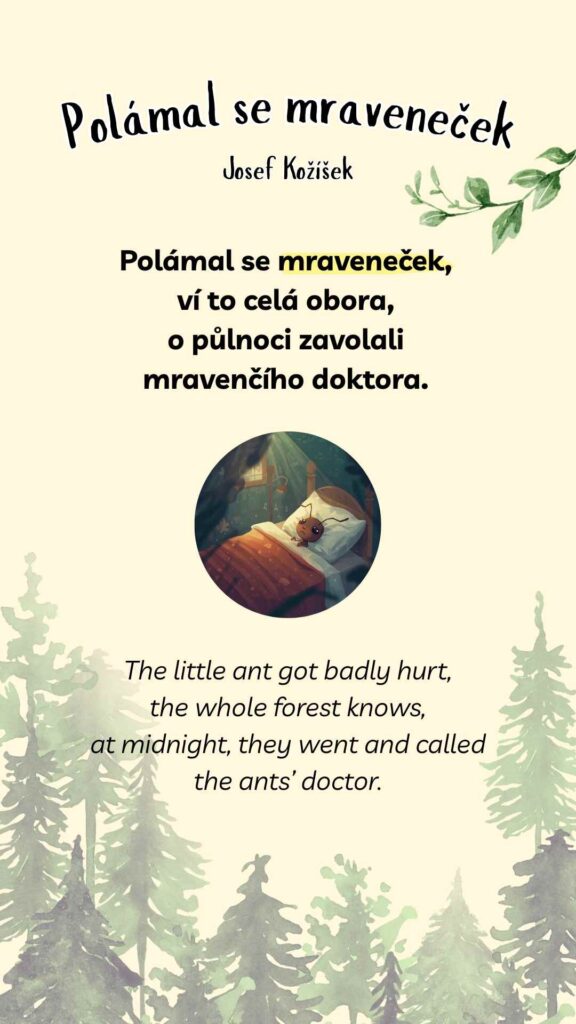
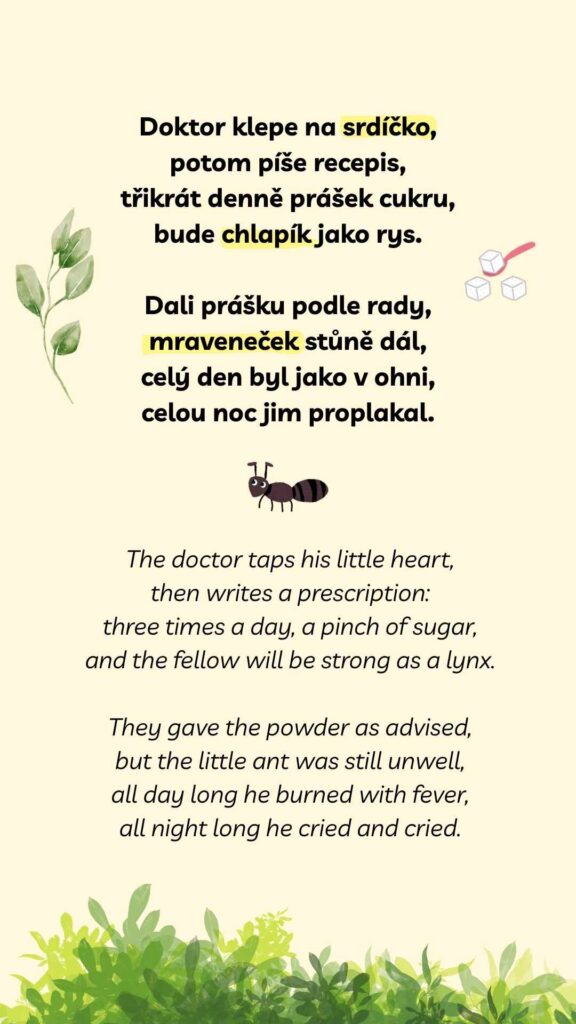
We’re going to take a look at words that are typically used in the diminutive forms. I will not comment on the changes that happen to the words yet – you will find that at the end of the article.
Family Members
Diminutives are extremely common when talking about family.
| Neutral | Diminutive | Meaning |
| máma | maminka | mommy |
| táta | tatínek | daddy |
| (bába) | babička | grandma |
| děda | dědeček | grandpa |
| sestra | sestřička | little sister; nurse |
| bratr | bratříček | little brother |
| mimino | miminko | small baby |
One interesting case is babička. Technically, it could be seen as a diminutive of bába, but in practice, babička is simply the normal word for grandma. The word bába exists, but it usually refers to an old woman and can even sound a bit rude (hag). So when talking about a grandmother, we almost always say babička.
First Names
Czech names have a whole ecosystem of affectionate forms. There are many more variations, but these are some of the most common.
| Neutral | Diminutive | Meaning |
| Honza | Honzík, Honzíček | little Honza |
| Petr | Petřík, Petříček | little Petr |
| Mirek/Miroslav | Mireček | little Mirek |
| Pepa | Pepík, Pepíček | little Pepa |
| Anna | Anička | little Anna |
| Jana | Janička | little Jana |
| Marie | Maruška | little Marie |
| Veronika | Verunka | little Veronika |
Body Parts
Diminutives are very common when talking to children about body parts. You might also notice that many diminutives contain soft sounds like č or š, which contribute to the “cute” feeling of the word.
| Neutral | Diminutive | Meaning |
| ruka | ručička | little hand |
| noha | nožička | little leg (also foot in inf. Czech) |
| hlava | hlavička | little head |
| prst | prstíček | little finger; toe |
| břicho | bříško | tummy |
Food and Drinks
Czech speakers also love diminutives for food. These forms often sound friendlier or more inviting. Simply, if we want to express that we are fond of certain food or drinks, the diminutive form is the perfect way to do it!
| Neutral | Diminutive | Meaning |
| jablko | jablíčko | (small) apple |
| vejce | vajíčko | egg |
| maso | masíčko | (nice) meat |
| polévka, polívka | polévčička, polívčička | soup |
| mléko, mlíčko | mléčko, mlíčko | milk |
| víno | vínečko | wine |
| pivo | pivko, pivečko | beer |
Animals
Diminutives are also common for animals, especially pets or toys.
| Neutral | Diminutive | Meaning |
| pes | psík, pejsek | doggy |
| kočka | kočička | kitty |
| ovce | ovečka | little sheep |
| žába | žabka, žabička | frogie |
| sova | sovička | little owl |
| medvěd | medvídek | small bear; teddy bear |
| štěně | štěňátko | puppy |
| kotě | koťátko | kitten |
| prase | prasátko | piglet |
Everyday Objects
You will also encounter diminutives for ordinary objects.
| Neutral | Diminutive | Meaning |
| auto | autíčko | little car; toy car |
| talíř | talířek | small plate |
| okno | okénko, okýnko | small window |
| slunce | sluníčko | little sun, nice sun |
| měsíc | měsíček | little moon; marigold; wedge |
How Do We Form the Czech Diminutives
First-Degree Diminutives
In Czech, diminutives are often divided into two degrees. The first degree usually means something that is simply smaller. Typical endings are:
- masculine gender: -ek, -ík
- feminine gender: -ka
- neuter gender: -ko
Take a look at these examples:
dům → domek (small house)
pes → psík, pejsek (small dog)
ocas → ocásek (small tail)
myš → myška (small mouse)
kniha → knížka (small book, book informally)
chvíle → chvilka (small moment)
okno → okénko (small window)
Second-Degree Diminutives
Second-degree diminutives sound even cuter or more affectionate. Typical endings include:
- masculine gender: -eček
- feminine gender: -ečka, -ička, -inka
- neuter gender: -ečko, -íčko
strom → stromeček (little tree)
Anna → Anička
máma → maminka
krabice → krabička (small box)
maso → masíčko (“nice meat”)
pivo → pivečko / pivíčko
Comparing the Two Degrees
Some words often have both forms.
strom – tree
stromek – small tree
stromeček – cute little tree
Another example: dům → domek → domeček
All refer to a small house, but domeček sounds more affectionate.
žába → žabka → žabička
myš → myška → myšička
máma → mamka → maminka
táta → taťka → tatínek, tatíček (more archaic)
Common Changes in Diminutive Forms
As you can see, forming diminutives in Czech is not only about adding a suffix (-ek, -ík, -eček, -ička…). The stem (in the middle part of the word) often changes as well, which is why some diminutives look surprisingly different from their base forms.
You can see various vowel changes, such as removing an acute accent:
chvíle → chvilka, žába → žabička, máma → maminka
adding an acute accent: ocas → ocásek, kniha → knížka
removing a vowel: pes → psík
or inserting a vowel: okno → okýnko, okénko.
Diminutive words can also look very different because of consonant softening:
kniha → knížka, břicho → bříško, pták → ptáček
As if it wasn’t enough, the letter ů in masculine nouns typically becomes o in diminutives:
dům (house) → domek → domeček
stůl (table)→ stolek → stoleček
nůž (knife) → nožík → nožíček
dvůr (courtyard, yard) → dvorek (small yard) → dvoreček (cozy little yard)
vůz (vehicle, wagon) → vozík (cart, trolley) → vozíček (little cart, wheelchair)
And sometimes the letter o becomes ů…
most (bridge) → můstek (small bridge, ski jump)
When Diminutives Become the Normal Word
Sometimes a diminutive becomes so common that we stop thinking of it as “cute” or “small“ but rather as an informal version of the word. For example:
svíčka – candle (from the older word svíce)
knížka – informal word for book (kniha)
básnička – rhyme; báseň is formal
písnička – song; píseň is formal
Interesting Meaning Changes
Sometimes a diminutive doesn’t mean a smaller or informal version of something but a completely different concept.
hodiny (clock) → hodinky (watch)
olej (oil) → olejíček (usually refers to essential oil)
chléb (loaf of bread) → chlebíček (a small loaf of bread you’ll enjoy but also an open-faced sandwich)
brambory (potatoes) → brambůrky (potatoes you are excited to eat and also potato chips)
vůz (vehicle, wagon) → vozík, vozíček (wheelchair)
Final Thought
Diminutives are everywhere in Czech. They can express smallness, affection, informality, or simply make a sentence sound friendlier. It’s natural to use them, as in other languages, especially Slavic languages.
Czech people will often say Budu tam za hodinku (I’ll be there in an hour) or ještě minutku / vteřinku (one more minute / second), emphasizing that it will only be a moment. Curiously, we don’t usually make diminutives of the words day, week, month, or year—perhaps because they are not that short.
If you’re thinking right now that you’ll never remember all those crazy changes words go through, please don’t panic! Just like with grammatical cases, the first step is simply learning to recognize that, for example, the word domeček is related to dům, sluníčko to slunce, and so on. Pick a few favorite words and start using them—have fun with them! Oh, and nouns are not the only words that can become cute. Czech speakers sometimes do the same thing with adjectives or even verbs. But that is a topic for another article.
By the way, do you know the diminutive of the word video? It’s videjko! So, don’t forget to watch my videjko on diminutives.
Now it’s time for practice. Jdeme na to!

 Shorter Words in Informal Czech
In Czech, some words have two forms with the same meaning. Sometimes…
-
-
 Czech Diminutives: Not Only Small & Cute 10.3.2026
 -
 Czech Modal Verbs Without Tears 17.12.2025
 -
-
 Second Position in Czech 24.4.2025
 -
 Making Nouns from Verbs in Czech 6.3.2025
-